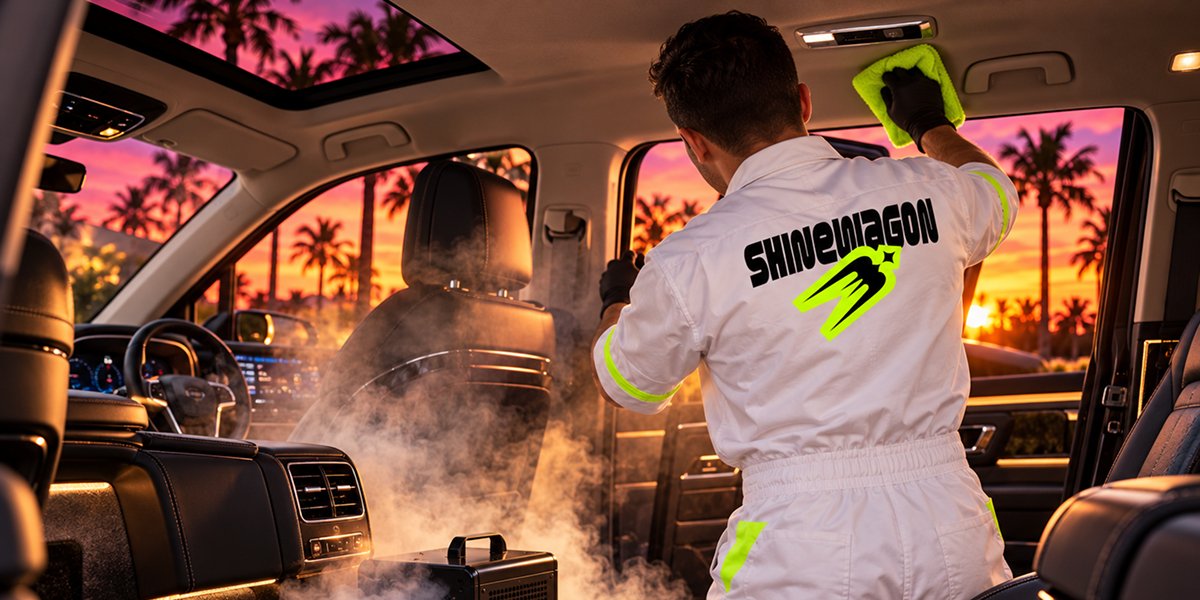
Smoke odor can be removed from most cars, but no spray or air freshener will do it alone. Cigarette smoke leaves a sticky film of tar and nicotine on every surface — headliner, seats, carpet, seat belts, glass and inside the air conditioning system. To get rid of the smell for good, that residue has to be physically cleaned out first, and only then neutralized with an oxidizing treatment such as ozone or chlorine dioxide.
Why Smoke Smell Is So Hard to Remove
Smoke is a mix of gases and tiny particles. The particles settle on surfaces and soak into porous materials, forming what’s often called “thirdhand smoke.” That residue keeps releasing odor long after anyone stops smoking — especially on hot days, when heat pulls odor compounds back into the air. In a Charlotte summer, a closed car cabin gets very hot, which is why a car that smelled “fine” in January can reek in July.
The main places odor hides:
- Headliner — smoke rises, and the fabric ceiling absorbs a lot of it.
- Seat fabric and foam — odor penetrates below the surface.
- Carpet and floor mats
- Seat belts — rarely cleaned, often overlooked.
- HVAC system and cabin air filter — the car recirculates odor every time the fan runs.
- Hard surfaces and glass — the yellowish film you see when you wipe the inside of the windshield.
Step 1: Remove the Source
Every effective odor job starts with cleaning, not deodorizing.
- Remove trash and ashtray contents and vacuum thoroughly, including under seats and in seat tracks.
- Clean hard surfaces with a diluted all-purpose cleaner — dash, door panels, console, vents. (See car detailing chemicals explained for how dilution affects safety.)
- Clean the glass inside until the film is gone.
- Shampoo and hot-water extract seats, carpet and mats to pull residue out of the fibers, not just off the top.
- Clean the headliner gently. Headliner glue can fail if it gets soaked, so use a low-moisture method.
- Replace the cabin air filter. A smoke-saturated filter will re-scent the cabin immediately.
Many cars become noticeably better after these steps alone. If odor remains, move on to neutralization.
Step 2: Neutralize What’s Left
| Method | How it works | Best for | Precautions |
|---|---|---|---|
| Ozone generator | Ozone (O₃) oxidizes odor molecules in the air and on surfaces | Heavy smoke odor after cleaning | Car must be empty of people and pets; ventilate fully before driving; overuse can age rubber and plastics |
| Chlorine dioxide (ClO₂) | Oxidizing gas released from a pouch or fogger | Smoke and mildew odor, including inside the HVAC system | Follow label exactly; no one inside during treatment; ventilate well |
| Enzyme cleaners | Enzymes break down organic matter | Milk, food, vomit, pet accidents | Limited effect on smoke tar, which isn’t mainly organic soil |
| Activated charcoal | Adsorbs odor molecules passively | Light maintenance after treatment | Slow; doesn’t fix a heavy problem |
| Fragrance sprays | Masks odor | Nothing long-term | Smell returns once fragrance fades |
Does Ozone Work?
Yes — ozone is one of the most effective ways to neutralize lingering smoke odor, but only after the residue is cleaned out. It reacts with odor compounds and breaks them down. Two important caveats: ozone is a lung irritant, so no person or pet should be in the vehicle during treatment, and the cabin must be aired out before anyone drives. Repeated high-dose treatments can also dry out rubber and some plastics, so more is not better.
Chlorine Dioxide vs. Ozone
Both are oxidizers. Chlorine dioxide products are popular because they come as self-contained “odor bombs” and can be circulated through the HVAC system. Ozone requires a generator. The choice matters less than the cleaning done beforehand.
Why Enzymes Aren’t the Best Choice for Smoke
Enzyme cleaners are excellent for biological stains — spilled milk, food, pet accidents. Smoke residue is a different chemistry, so enzymes alone usually disappoint here. If your car has mixed odors — smoke plus pet or mildew smells — each source needs its own treatment. See our guides to removing pet hair and fixing a musty smell in your car.
Mistakes That Make Odor Worse
- Hanging stronger air fresheners — the mix of fragrance and smoke often smells worse.
- Soaking seats without extracting — wet foam holds odor and can grow mildew.
- Skipping the cabin filter.
- Running an ozone treatment without cleaning first — it neutralizes some odor but leaves the residue that keeps producing it.
Why It Matters When Selling or Returning a Car
Smoke odor is one of the fastest ways to lose value. Buyers notice it within seconds, and many leasing companies treat smoke damage as excess wear. If you’re planning to sell, read does detailing increase resale value; if your lease ends soon, see lease return detailing.
When to Call a Professional
Heavy smoke odor takes hot-water extraction equipment, headliner-safe cleaning and controlled neutralization — usually several hours of work. A mobile interior detail in Charlotte can handle the deep clean at your home or office. Send a photo of the interior and describe how long the car was smoked in, and you’ll get an honest estimate of what’s recoverable.
FAQ
Light odor can improve in a single deep interior clean. A car smoked in for years may need a full clean plus one or more neutralization treatments, and a small amount of odor may return in hot weather.
No. Air the vehicle out with doors open until the sharp ozone smell is gone before anyone sits inside.
It removes one source but not the residue on fabrics and surfaces. It’s a necessary step, not a full solution.
SHINEWAGON Mobile Detailing Location
Book Mobile
Detailing Today